Sylvia Parrish, Chief Business Columnist
July 02, 2026 · 13 min read
Verify Puerto Rico luxury real estate for Act 60 compliance
A penthouse in Condado, $2.4 million closing, champagne on the terrace — and then eighteen months later, a letter from the IRS that reads like a restraining order against your tax strategy.
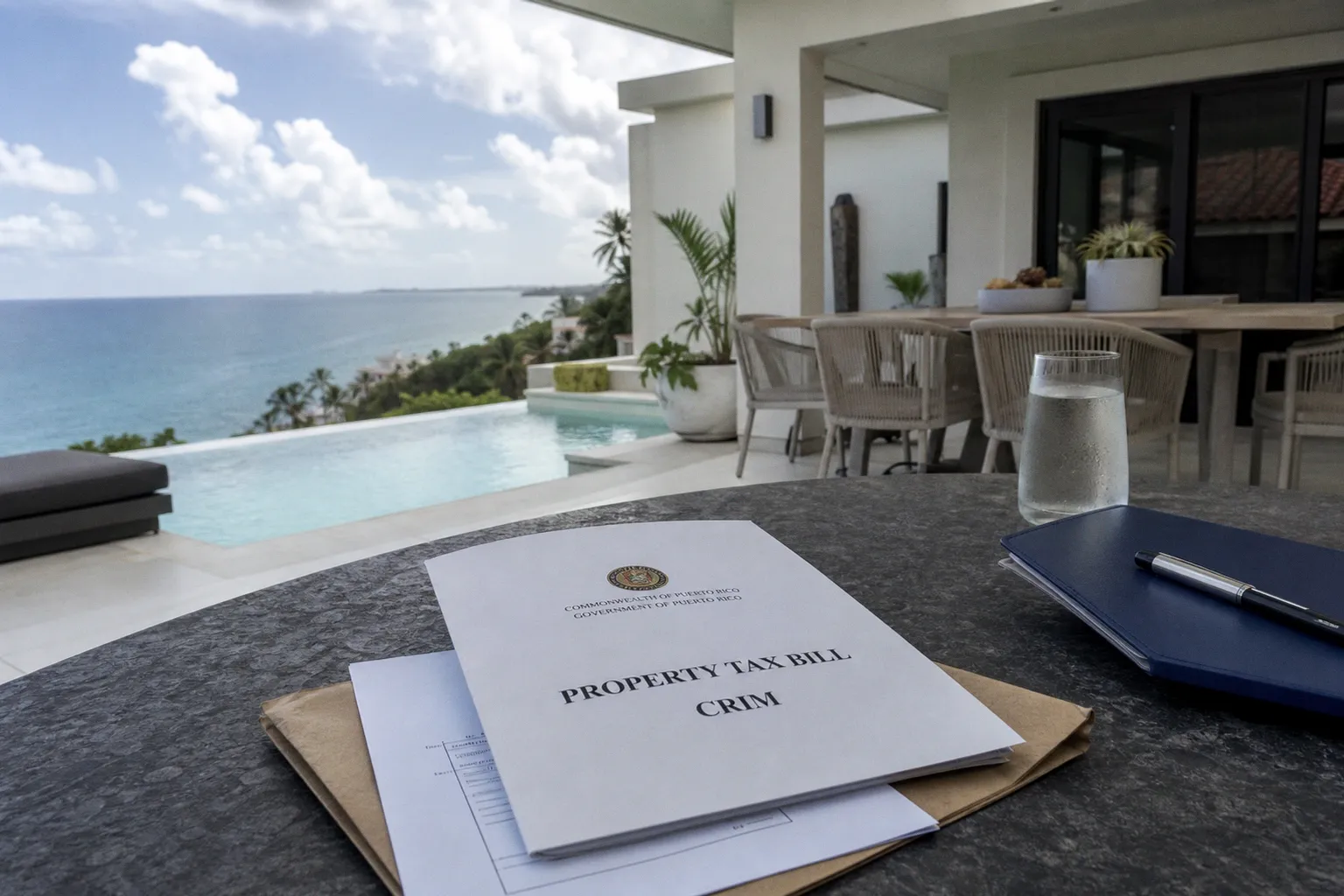
Let me be blunt. The entire architecture of Puerto Rico's tax incentive regime sits on one load-bearing wall: bona fide residence. Fail that test and your 100% exemption on dividends, your 4% corporate rate, your 75% property-tax reduction — all of it collapses like a house built on sand. And luxury real estate, contrary to the fantasies whispered at networking mixers in Dorado Beach, is not the golden ticket. It's the entry point. The difference matters enormously, and it's the difference I'm going to unpack here.
The Nexus Between Luxury Property and Bona Fide Residency
Here's the friction most newcomers miss: Act 60 doesn't say "buy a condo, get the tax break." What it says, in the cold language of the Puerto Rico Incentives Code, is that you must establish and maintain a bona fide residence on the island. That's a legal term of art, and it carries specific evidentiary weight.
Owning — or leasing — a residential property is the primary mechanism through which you demonstrate that residency. But it's not the proof itself. Think of the property as the skeleton; you still need to hang muscle and sinew on it. The IRS, and before them the Puerto Rico Department of Economic Development and Commerce (DDEC), want to see that this is where you actually live, not a pied-à-terre you visit four weekends a year while your real life — your dentist, your brokerage account's mailing address, your voter registration — stays in Connecticut.
What does bona fide residence look like in practice?
- A primary residential address that is demonstrably your main dwelling — not a vacation home held through an LLC for asset protection.
- Utility bills, mail delivery, and local bank accounts tied to that address, showing continuous economic life on the island.
- Social and community integration — membership in local organizations, children enrolled in local schools if applicable, a Puerto Rico driver's license, voter registration (yes, you can register for local elections as a resident).
- Consistent physical presence, which brings us to the number everyone fixates on — and the number that, alone, is insufficient.
Buying luxury real estate in Puerto Rico without building genuine residency around it is like buying a Rolex and calling yourself punctual. The asset signals intent. The lifestyle must prove it.
I've seen people spend north of $5 million on oceanfront estates in Palmas del Mar, then get flagged because their Amazon shipping address never changed from Manhattan. The IRS isn't stupid. They know the difference between someone who moved and someone who's playing dress-up.
Navigating the 183-Day Physical Presence Requirement
The 183-day rule is the headline number, the one every Act 60 seminar fixates on. And yes, it's real — you must spend at least 183 days per year physically present in Puerto Rico to satisfy the residency requirement. But treating it as a checkbox is where people get into trouble.
First, the logistics. The IRS doesn't take your word for it. They want corroborating evidence: utility bills showing continuous habitation, cell phone location data (yes, they can subpoena that), airline records, credit card swipes. The 183-day threshold is a minimum, not a target. If you're spending exactly 183 days and 182 of them are on a beach in Isla Verde while your "business" conveniently happens over Zoom from a Miami hotel room on the other days, an auditor will eat you alive.
Here's what I advise anyone who asks — and they ask constantly, usually at parties where they're already two Negronis deep and looking for validation:
| Evidence Type | What It Proves | Risk Level If Absent |
|---|---|---|
| Utility bills (continuous, at property address) | Habitation, not vacancy | High — primary red flag |
| Airline boarding passes / travel records | Actual days on-island vs. mainland | Critical for auditors |
| Cell phone location metadata | Geolocation tied to Puerto Rico | Increasingly used by IRS |
| Local bank account activity | Economic life based on island | Moderate — strengthens nexus |
| Puerto Rico driver's license | Legal residency intent | Moderate — expected standard |
The 183 days also need to be substantive. If you're a hedge fund manager who flies in every Monday morning and out every Thursday night, technically present but functionally absent, you're building a residency claim on sand. The IRS has become adept at piercing this kind of theatrical compliance. Especially post-2023.
The Day-Counting Trap
A practical note on tracking: don't rely on a wall calendar and optimism. Use a dedicated app or spreadsheet that logs every single day with supporting documentation. I've seen audit cases turn on three days — three days — where the taxpayer couldn't prove they were on-island. The penalty? Retroactive taxation on income they'd already exempted, plus interest, plus the psychic damage of realizing your accountant's spreadsheets were fiction.
Economic Substance and IRS Scrutiny in the Post-2023 Landscape
Let's talk about the elephant in the room. The IRS has significantly escalated enforcement around Act 60 claims, and 2023 was the inflection point. The agency started targeting participants who claim Puerto Rico tax residency while maintaining what investigators diplomatically call an "insufficient economic nexus" — and what I call living in Miami with a Puerto Rico mailing address.
The increased scrutiny isn't theoretical. Audits are active, ongoing, and increasingly sophisticated. The IRS is cross-referencing bank records, social media activity (yes, your Instagram posts from the Hamptons in August are evidence), and even HOA records from mainland properties. If you're claiming to live in Puerto Rico while maintaining a mainland residence that looks suspiciously like your actual home, expect friction.
Here's what the IRS specifically looks for when assessing economic substance:
1. Source of income — Is your income genuinely Puerto Rico-sourced, or are you attempting to recharacterize mainland income as island-earned? Act 60 primarily exempts Puerto Rico-sourced income; it does not provide blanket immunity from US federal taxes on all earnings.
2. Business operations — Do you have actual employees, office space, or clients in Puerto Rico? A letterhead with a San Juan address and no operational footprint is a mirage.
3. Banking and financial ties — Where do the funds flow? If your primary brokerage account is still domiciled in New York, your claim weakens with every wire transfer that routes through Manhattan.
4. Lifestyle integration — This is the squishy but real criterion. The IRS looks at the totality of circumstances: where do your children attend school, where does your spouse work, where do you receive medical care?
The IRS doesn't audit your zip code. They audit your life. And if your life is still in Boca Raton with a forwarding address to Condado, no amount of luxury square footage will save you.
I've watched high-net-worth individuals get this catastrophically wrong. They treat Act 60 like a purchase — buy the condo, file the paperwork, collect the savings. But it's not a transaction. It's a lifestyle transformation, and the compliance framework reflects that reality. The people who succeed — who maintain their exemptions year after year without drama — are the ones who genuinely relocated. Their kids go to school in Guaynabo. Their Friday nights are in Santurce. Their tax home is Puerto Rico in every way that matters.
Maintaining Property Records for Tax Decree Protection
Your luxury property isn't just your residence under Act 60 — it's your primary exhibit in any compliance review. And like any exhibit, it needs to be curated, documented, and defensible.
The DDEC requires that Act 60 beneficiaries maintain their property in a manner consistent with bona fide residency. That means it can't sit vacant for months at a stretch. It can't be listed on Airbnb for half the year while you claim it as your primary dwelling. And critically, it must be properly registered and taxed through CRIM — Puerto Rico's property tax system, known formally as the Centro de Recaudación de Ingresos Municipales.
Here's where the details get granular, and where I see the most expensive mistakes:
Property tax (CRIM) compliance is non-negotiable. Act 60 beneficiaries may receive up to a 75% exemption on property taxes under certain decree terms, but the remaining 25% must be paid, on time, every period. Failure to pay CRIM obligations can — and has — been used as evidence that the beneficiary isn't maintaining bona fide residency. A property with delinquent tax records looks abandoned, and abandoned property is the opposite of a residence.
Document everything. Keep records of all maintenance, renovations, and improvements. Maintain copies of every utility bill, every insurance payment, every HOA fee. This isn't paranoia — it's the foundation of your defence if the IRS or DDEC comes asking questions.
Property through an entity vs. personal ownership. Many high-net-worth buyers in Puerto Rico hold luxury real estate through LLCs or trusts for asset protection. That's legitimate and common, but it creates an additional layer of documentation. You need to demonstrate that despite the corporate veil, you personally reside at the property. Lease agreements between the entity and yourself, personal mail delivery to the address, and consistent presence records all bridge this gap.
The Rental Income Complication
If you're generating rental income from your Puerto Rico property — even short-term — be aware that this complicates the bona fide residency claim. A property that earns rental income is, by definition, an investment property. The IRS may argue that your "residence" is actually a commercial asset, undermining the very claim it's supposed to support. This doesn't mean you can never rent it out, but the ratio of personal use to rental use matters enormously. If you're spending 200 days a year in the property and renting it for 30 days during a period you'd be travelling anyway, that's defensible. If the math flips, you have a problem.
Strategic Management of CRIM Obligations and Local Tax Exemptions
CRIM is one of those mundane-sounding administrative details that, in practice, can make or break an Act 60 strategy. Most mainland transplants barely know it exists until a tax advisor mentions it in passing — and by then, a bill may already be overdue.
Puerto Rico's property tax system operates differently from mainland assessments. CRIM calculates taxes based on the property's assessed value (which often lags significantly behind market value), and the rates are notably lower than comparable mainland jurisdictions. For a luxury property assessed at $1.5 million, annual CRIM obligations might run in the range of $5,000–$12,000 before exemptions — a rounding error compared to property taxes in, say, Greenwich or Palm Beach.
But the exemption structure requires attention:
| CRIM Element | Detail | Compliance Implication |
|---|---|---|
| Base assessment | Typically below market value | Lower tax burden, but verify accuracy |
| Act 60 exemption (up to 75%) | Applied via decree; not automatic | Must be filed and approved by DDEC |
| Remaining obligation | 25% of assessed CRIM amount | Must be paid on schedule — delinquency = red flag |
| Reassessment cycle | Periodic, not annual | Monitor for changes that affect exemption calculations |
| Filing requirements | Separate from federal/PR income tax | Often missed by newcomers; penalties apply |
The strategic play here is straightforward: stay current, stay organised, and don't try to game the exemption. I've seen beneficiaries attempt to claim exemptions on properties they weren't actually residing in, or inflate the primary-residence claim to cover a secondary property. The DDEC is getting better at cross-referencing, and the reputational risk of an Act 60 enforcement action — which becomes public record — far outweighs the few thousand dollars you might save.
What Happens If Compliance Breaks Down
Let me paint the picture people don't want to see. If your bona fide residency claim fails — whether through IRS audit or DDEC review — the consequences cascade:
- Retroactive taxation on all income previously exempted under Act 60, going back to the first year of non-compliance.
- Interest and penalties on the unpaid federal tax liability, which can compound aggressively.
- Loss of the decree itself, meaning you forfeit future benefits and must reapply (which is neither quick nor guaranteed).
- Reputational damage in a community where Act 60 beneficiaries are already viewed with a mixture of welcome and wariness.
The total financial exposure in a serious compliance failure can easily reach seven figures. I've seen it happen to people who spent $3 million on a beachfront estate in Rincón and then couldn't prove they'd spent more than 90 days there in a given year.
The Real Cost of Getting It Right
Here's the uncomfortable truth that nobody at the glossy Act 60 networking events wants to discuss: compliance is ongoing work. It's not a one-time filing. It's a lifestyle architecture — the deliberate construction of a life in Puerto Rico that satisfies both the letter and spirit of the incentive code.
The people who do this well aren't the ones who bought the most expensive property. They're the ones who moved — genuinely, thoroughly, and with intention. They learned enough Spanish to navigate a CRIM office. They found a local accountant who understands both Puerto Rican and federal tax law. They embedded themselves in the community, not as tourists with tax advantages, but as residents who happen to have optimised their financial structure.
And yes, they still enjoy the beaches, the food, the culture — and perhaps, during those long tropical evenings with time on their hands, they indulge in niche pursuits they never had time for on the mainland. Some discover new hobbies and passions they'd never have explored in the grind of their former lives. That's the human side of a tax relocation that the compliance manuals never capture.
But make no mistake: the foundation is compliance. Property ownership gets you in the door. The 183 days keep you in the room. Economic substance and meticulous record-keeping are what prevent the IRS from showing you the exit.
Puerto Rico's Act 60 remains one of the most compelling tax incentive structures available to US persons. The exemptions on dividends and interest alone — 100% for qualifying residents — represent generational wealth preservation. The 4% corporate rate for export service businesses is a genuine competitive advantage. But leverage always has a cost, and the cost here is commitment. Half-measures don't survive contact with an auditor who's seen every trick in the playbook.
Buy the property. But then — and this is the part most people skip — actually live in it. That's the compliance strategy. Everything else is paperwork.